

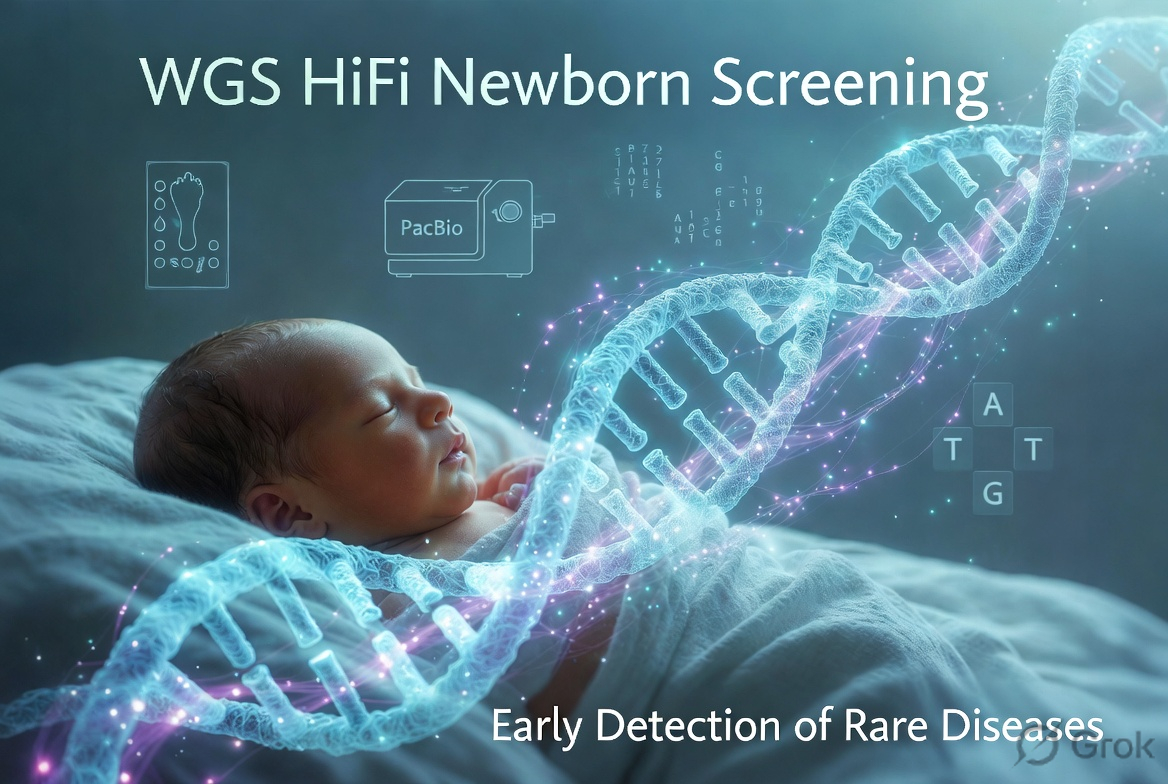
Newborn Screening for Rare Diseases by 4 Power Biomarkers WGS-HiFi Test
Unlocking Early Detection: How Whole Genome Sequencing (WGS) with HiFi Technology is Revolutionizing Newborn Screening for Rare Diseases
Newborn screening (NBS) has long been a cornerstone of preventive healthcare, saving countless lives by identifying treatable conditions before symptoms appear. Traditional NBS relies on biochemical tests from a simple heel-prick blood spot, screening for a limited panel of disorders. However, many rare genetic diseases—often caused by complex structural variants, repeat expansions, or variants in hard-to-sequence regions—slip through undetected until irreversible damage occurs.
Enter 4 Power Biomarkers WGS HiFi test; the Whole Genome Sequencing (WGS) using HiFi (High-Fidelity) technology, pioneered by platforms like PacBio. HiFi sequencing delivers long, highly accurate reads (typically >99.9% accuracy with 10–20 kb lengths), enabling comprehensive detection of single nucleotide variants (SNVs), insertions/deletions (indels), structural variants (SVs), repeat expansions, and even epigenetic markers like methylation—all in a single test. Unlike short-read sequencing, HiFi excels at phasing variants (determining which allele they occur on) and resolving complex genomic regions, making it ideal for rare disease diagnostics in newborns.
Recent real-world applications highlight its potential. In May 2025, Thailand launched Asia’s first population-scale HiFi WGS newborn screening program in collaboration with Chulalongkorn University and PacBio—the first in the Asia-Pacific region—to identify rare and treatable conditions early. Studies have shown HiFi WGS works effectively even on low-input DNA from dried blood spots, as demonstrated in research on cystic fibrosis where it successfully phased pathogenic CFTR variants over long distances without needing parental samples.
Why Early Detection of Rare Diseases Matters
Rare diseases, defined as affecting fewer than 1 in 2,000 people, collectively impact millions—especially in diverse populations like India’s. Many are genetic, progressive, and devastating if untreated, but highly manageable or even curable when caught at birth.
Key benefits of early detection include:
- Prevention of irreversible damage: Early intervention (e.g., enzyme replacement therapy, special diets, or gene therapies) can halt disease progression before symptoms like developmental delays, organ failure, or neurological damage set in.
- Improved long-term outcomes and quality of life: Treated infants often achieve normal development, reducing lifelong disability, hospitalizations, and healthcare costs.
- Family planning and cascade testing: Diagnosis informs parents about recurrence risks (e.g., 25% for recessive disorders) and enables carrier screening for future pregnancies.
- Public health impact: In resource-limited settings, early action minimizes the economic and emotional burden on families and healthcare systems.
Without early screening, families often endure a “diagnostic odyssey” lasting years, with misdiagnoses and missed treatment windows. Genomic NBS shifts this paradigm from reactive to proactive care.
Real-World Examples of Rare Diseases Detectable by 4 Power Biomarkers WGS HiFi
WGS HiFi shines where traditional tests fall short, identifying conditions missed by biochemical assays or short-read methods:
- Pompe Disease (Glycogen Storage Disease Type II): Caused by GAA gene variants leading to muscle weakness and heart failure. Early enzyme replacement therapy (ERT) prevents infantile-onset cardiomyopathy and motor delays. HiFi detects complex variants accurately.
- Spinal Muscular Atrophy (SMA): SMN1 deletions or variants cause progressive muscle wasting. Newborn screening enables immediate access to therapies like nusinersen or gene replacement (e.g., onasemnogene), dramatically improving survival and mobility when started pre-symptomatically.
- Lysosomal Storage Disorders (e.g., Gaucher, MPS I): Enzyme deficiencies causing organ enlargement and skeletal issues. HiFi identifies SVs and repeat expansions; early ERT or substrate reduction therapy prevents irreversible damage.
- Urea Cycle Disorders (e.g., OTC deficiency): Life-threatening hyperammonemia. Dietary management and medications started at birth can be lifesaving.
- Myotonic Dystrophy or CDKL5-related Epileptic Encephalopathy: Repeat expansions or intronic insertions detected only by long-read HiFi, explaining undiagnosed seizures or developmental issues.
In pilots, WGS has identified treatable conditions in 1–2% of newborns beyond standard panels, with experts endorsing dozens of gene-disease pairs (e.g., OTC, G6PC, IDS) for inclusion.
Current Guidelines for Genetic Testing in Newborns
Globally:
- The U.S. Recommended Uniform Screening Panel (RUSP), curated by the American College of Medical Genetics and Genomics (ACMG) and HRSA, recommends ~35–40 core conditions (mostly biochemical) for universal NBS. Genomic sequencing is not yet routine for all newborns but is endorsed for rapid WGS/WES in critically ill NICU infants or those with congenital anomalies/intellectual disability.
- ACMG guidelines support exome/genome sequencing in pediatric diagnostics and emphasize evidence-based gene selection, variant interpretation (using ACMG criteria), and ethical considerations like consent and secondary findings. Research programs (e.g., BabySeq) are evaluating broader genomic NBS.
In India:
- No national universal genomic NBS policy exists yet. The National Neonatology Forum (NNF) and ICMR recommend screening for congenital hypothyroidism (CH), congenital adrenal hyperplasia (CAH), and G6PD deficiency—conditions with high prevalence in India.
- The National Policy for Rare Diseases (2021) advocates targeted newborn screening for inborn errors of metabolism (via LC-MS/MS), SCID (TREC assay), and lysosomal storage disorders, alongside prenatal options for high-risk families. It designates Centers of Excellence and Nidan Kendras for diagnostics and care.
- ICMR multicentric pilots have demonstrated feasibility, but implementation remains fragmented and mostly biochemical. Emerging initiatives like GENESIS are exploring genomic NBS to address India’s high burden of rare genetic disorders.
How Nucleome Informatics Can Help in Rare Disease Genetic Testing for Newborns
As India’s leading bootstrapped genomics company with 13+ years of clinical expertise, Nucleome Informatics (through its DrSeq clinical genomics vertical) is uniquely positioned to bridge this gap. We offer accredited, high-quality WGS HiFi sequencing specifically tailored for rare disease diagnostics, including unresolved cases where short-read methods fail.
Our services include:
- Comprehensive newborn genetic panels and full WGS HiFi for early detection of rare/inherited disorders.
- Advanced bioinformatics for accurate variant calling, phasing, and clinical interpretation—delivering actionable reports with genetic counseling.
- Scalable solutions suitable for dried blood spots, enabling integration into existing NBS workflows.
- Expertise in India-specific genetic diversity, supporting population-scale programs for oncology, rare diseases, and precision medicine.
Nucleome’s HiFi capabilities empower hospitals, pediatricians, and public health programs to expand newborn screening beyond traditional limits—identifying treatable rare diseases early and improving outcomes for Indian families. By partnering with clinicians and policymakers, we can help scale genomic NBS, making advanced testing accessible, affordable, and impactful across the country.
A Healthier Future Starts at Birth
WGS HiFi represents the next frontier in newborn screening: precise, comprehensive, and transformative for rare diseases. As India’s genomics ecosystem matures, adopting such technologies will be key to reducing the burden of genetic disorders. Early detection isn’t just about diagnosis—it’s about giving every child the healthiest possible start.
Nucleome Informatics is ready to support this vision. For collaborations, implementation support, or to learn more about our rare disease and newborn genomic testing solutions, reach out to our team. Together, we can make genomic newborn screening a reality in India.
Contact us now for more information.
Sorry, the comment form is closed at this time.